- Home
- Guide to This Website
- Take Action for Human Rights
- Disabled
- GHB - Xyrem
- Human Rights
- Human Persons vs Corporations
- Law Enforcement
- Legal
- Mental Health Rights
- Medical Fraud
- PTSD
- Psychiatric Rights
- Residental Treatment Abuse
- Sexual Assault
- Whistleblowers
- Native American
- Women's Rights
- Aertoxic Syndrome
- Food & Drug Administration - Off Label
- The Emperor's New Clothes
- NAFTA Foreign Investor Privileges
- MWAN UN Reports
- Supreme Court Decision - Citizens United
- Do You Know What a Dragon Looks Like?
- Mass Murder and Psychiatric Drugs
- Patients not Consumers
- La Experimentación no Consensual Spanish
- Medical Deferred Action Immigration Cases
- Voting Rights for Residents of the District of Columbia
- Benefits Trafficking
“All human beings are born free and equal in dignity and rights. They are endowed with reason and conscience and should act towards one another in a spirit of brotherhood.”
Universal Declaration of Human Rights
Article 1
Visitors
2335791
What is Charitable Choice?

Religious organizations have long been involved in provision of services to the communities they live in and work in. Catholic Charities or United Jewish Communities have long provided services, but maintained a bright line to ensure the separation of church and state/federal funding. Thus these religious organizations put in place safeguards to protect the integrity of the religious organization as well as the interests of state/federal taxpayers. These religious organizations did not contract directly with the government; rather, religious institutions created separate entities (usually 501(c)(3)s) to handle public funds and did not incorporate religion into the publicly funded program.
The "Charitable Choice" provision (section 104) of the Personal Responsibility and Work Opportunity Reconciliation Act of 1996 (welfare reform legislation) meant to privatize welfare requires states that contract with nonprofit organizations for delivery of social services to include religious organizations as eligible contractees. The goal of Charitable Choice was to end the welfare system of entitlement money that provides a safety net for the poor and needy and instead turn the system into a privatized system where corporate and non-governmental service agencies compete to provide services.
The Charitable Choice provisions although they were first signed into law under President Clinton, Clinton himself indicated that his Administration would not “permit governmental funding of religious organizations that do not or cannot separate their religious activities from federally-funded program activities” because such funding would violate the Constitution. There were constitutional limitations that prohibited the direct funding of houses of worship and government-funded employment discrimination. It was federal law that no federal money should go to organizations that were pervasively sectarian, no money went to any organization with the Title VII exemption.
But President George W. Bush had other ideas for Charitable Choice. Under his administration Charitable Choice was vastly expanded through a series of Executive Orders. In 2001, Executive Orders 13198 and 13199 created and set out organizational guidelines for a White House Office of Community and Faith-Based Initiatives. Th us when entering office, President George W. Bush issued an executive order which became known as the Faith-Based Initiative which created a bureaucracy with the sole purpose of providing support to faith-based providers of social services.
There were several Presidential executive orders issued by President George W. Bush. First there were 3 orders [Executive Orders 13280 (2002), 13342 (2004), and 13397 (2006)] which mandated that the departments of Justice, Education, Labor, Health and Human Services, Housing and Urban Development, Agriculture, Commerce, Veteran Affairs, and Homeland Security, the Agency for International Development and the Small Business Administration all establish a Center for Faith-Based and Community Initiatives.
But the constitutional concerns about discrimination using federal money came when in 2002 President George W. Bush issued Executive Order 13279 – which made it easier for churches and other faith-based organizations to receive federal money by letting them circumvent certain anti-discrimination laws.
This opened the door to biased hiring practices and to biased provision of services for Faith-based and Community Initiative programs paid for with Charitable Choice funding. Proselytization with federal funds violates the First Amendment to the Constitution.
Anti-Defamation League Letter to President Obama: expressing that federal funding of faith organizations should include essential constitutional safeguards for protecting religious organizations, beneficiaries, and the government [February 19, 2009]
There had been a long history of religious group receiving funding to provide social services and being able to do so in a manner consistent with Constitutional Civil Rights protections. There had been long-standing legal provisions regarding faith-based organizations’ participation are: (1) allowing proselytization during a secular, government-funded program; and (2) permitting employment discrimination with federal funds.
Now suddenly there was the Bush Presidential Executive Orders which directly led to proselytization and also prohibited personnel practices with federal funding from Charitable Choice.
If we as a nation fail to enforce civil rights in federal programs, we lose our moral authority to impose those laws on private employers and thus loose the ability to enforce our fundamental civil rights.
So a controversy exists because many are concerned that charitable choice blurs the separation of church and state. The nature of religious non governmental agencies and the fact that there is not direct supervision or auditing of funds means that it is possible for funds to flow in a biased way toward one particular denomination or religious tradition. Others argue that federal financial support of faith-based organizations creates an opportunity for abuse both for fraud against the federal taxpayer and lack of quality control.
Although in theory this might sound like a system to save money and be economical with public funds, it ignores the basic reality of possible fraud by incorporated NGO's such as residential treatment facilities, privately run hospitals, welfare programs and private prisons and many others run by religious NGO's and who might take advantage of the decreased federal oversight and transparency. This problem has been evident in faith based prison programs and also in programs such as Teen Challenge which were religious NGO run residential treatment centers.
http://www.bobbyscott.house.gov/index.php?option=com_content&view=article&id=295
“The foundation of morality should not be made dependent on myth nor tied to
any authority lest doubt about the myth or about the legitimacy of the authority imperil
the foundation of sound judgment and action. ”
Albert Einstein
Charitable Choice Policy in Texas

George W. Bush as governor of Texas rapidly incorporated the provisions of Charitable Choice into Texas policy and politics. It was in Texas that the first state Faith Based Liaison positions were created. But there was opposition to the charitable choice proposals by the members of the Texas Faith Network which is made up of more than 400 clergy.
 Rabbi Peter Berg of Temple Emanuel in Dallas Texas asked “Who will decide which churches or synagogues, which denomination or sect, will be funded and which will be excluded?” There was clearly a lack of accountability on one hand and the unconstitutional lack of separation of church and state on the other. Thus although faith-based groups certainly play an important role in provision of social services, it is still necessary that they remain independent from the government. Taxpayers through the faith-based initiatives program end up financially supporting religious activity, but with no accountability or transparency for how that money is spent. There are strings that come with governmental money and also poor people are compelled to practice a faith that is not their own just to get services.
In 1995, George W. Bush’s first year as governor of Texas, Teen Challenge a Christian based drug treatment program was threatened with closure by a state regulatory agency, The Texas Commission on Alcohol and Drug Abuse. Although Teen Challenge did not receive any government funds, it did offer treatment to drug users and therefore fell under the state’s regulatory powers. The Texas Commission on Alcohol and Drug Abuse (TCADA) threatened to close the doors of Teen Challenge for violations of its regulations in April 1996. Roloff Homes was also a program supported by George W. Bush and it was also in violation of basic health and safety regulations. So two programs who were in trouble with the state of Texas for dangerous treatment practices were publicly defended by religious right leaders. Bush publicly defended these programs and changed state law to protect them even at the expense of quality of care and public safety.
In the mid 90s, Texas Commission on Alcohol and Drug Abuse (TCADA) attempted to close down the San Antonio branch of Teen Challenge, a residential Christian program that relies solely on faith-based methods to treat drug abuse. According to a TCADA spokesperson, the organization violated Texas state policies, procedures and licensure standards. There were problems with hiring practices, not meeting training requirements for counselors, client grievance procedures, release of confidential records. Teen Challenge was also charged with disregarding state standards for the screening, orientation, treatment and discharge of follow-up of clients (Austin American Statesman, July 2, 1995).
In June 1995, TCADA suspended Teen Challenge’s license based violations that may even cause a potential danger to the residents. Bush intervened publicly on behalf of the faith-based program, saying TCADA was following procedure and stating publicly that he strongly supported the faith-based programs. (World Magazine 1995).
On Bush’s urging and other outside pressures, TCADA postponed judgment of the organization, dropped licensure demands, and agreed to wait until the legislature considered bills that would change the rules for faith-based organizations. According to the Houston Chronicle, the flap about Teen Challenge made the organization-a cause celebre among the religious right, placing Teen Challenge to the forefront of the faith-based self-help movement. Support came not only from Christian leader Pat Robertson, who featured the group on his 700 Club television show, but also from the conservative policy crowd (Houston Chronicle, December 1, 1995)
On May 2, 1996 Governor Bush in a show of continuing support of such organizations, Bush vowed to assembled an Advisory Task Force made up of 16 clergy and volunteer leaders and charges the Task Force with 2 objectives: (1)survey Texas legal and regulatory landscape to identify obstacles to faith-based groups and (2)recommend ways that Texas can create an environment in which these groups can thrive, free of regulations that dilute the faith factor.
On August 22, 1996 The Personal Responsibility and Work Opportunity Reconciliation Act is signed in law (PL 104-193). Section 104 of this federal welfare reform legislation - authored by then-Senator John Ashcroft - opened the door to so-called Charitable Choice provisions that allow states to contract with faith-based and community-based organizations for the provision of welfare services. This provision has been interpreted to apply to Temporary Assistance to Needy Families (TANF), Social Security Income (SSI), food stamp and Medicaid programs.
In 1997 legislation was passed exempting religious child care and drug treatment facilities from health and safety regulations.
"Those in power need checks and restraints lest they come to identify the common good for their own tastes and desires, and their continuationin office as essential to the preservation of the nation."
William O. Douglas
(1898-1980), U. S. Supreme Court Justice
Source: We, The Judges, 1956
Welfare Reform - Paving the way to Privitization
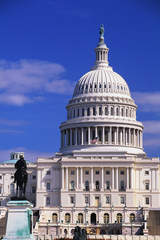
In 1996 a welfare reform bill called the Personal Work and Responsibility
Act (PWORA) was enacted and signed into law by President Bill Clinton.
The Personal Work Opportunity and Reconciliation Act, PWORA, has
altered the landscape of American religion. Embedded in the PWORA was a
small provision Section 104 also known as Charitable Choice, which
makes it illegal for state governments to discriminate against social
service providers whose organization, has a religious mandate. President
Bill Clinton during his presidency did not do a lot to further it. The
PWORA was implemented primarily through a variety of executive orders
issued by President George W. Bush. Executive Order 13199 by President
George W. Bush called for eliminating “unnecessary legislative,
regulatory and other bureaucratic barriers that impede effective faith
based and other community efforts to solve social problems”. Charitable
Choice blurred the boundaries between Church and State. Faith based
initiatives were policies that were based in a larger concept of fiscal
conservatism, decreasing the size of federal government, along with
collaboration and cooperation in partnership with the religious
community. Thus through Charitable Choice a stamp of authority was
given to change the basic way in which the church and state interact.
These faith based initiatives appeal to conservatives who want to
decrease the size of government and see the initiatives as providing an
inexpensive alternative to government-sponsored social services. The
withdrawal of federal funding for social services creates a void which
places the burden of care upon the nonprofit sector. This is sometimes
called the “hollow state,” in which the government is much less active
in its role for the financial responsibility to provide welfare
services.
Prior to Charitable Choice, all 50 states already worked with religious
organizations to provide social services. Many larger religious
organizations have long been a part of the traditional provision of
social services to the public through separate nonprofit agencies such
as the Catholic Charities and Lutheran Social Services. These agencies
are religiously influenced, but maintained separate nonprofit
organizations through separate 501 C 3 IRS filings and did separate
their social service functions from their purely religious functions (a
bright line). These new faith based initiatives paved the way for a
political system which relies more heavily on religious organizations
and partnerships with them, while removing federal governmental funding
for social services. This places a greater burden on the faith based
community to take up the slack during the cuts in governmental funding
through their own fund raising efforts.
But not everyone was in agreement that Charitable Choice was an
appropriate way to spend taxpayer’s dollars. The Washington, D.C. based
Americans United for Separation of Church and State is a religious
freedom advocacy group in the United States which promotes the
separation of church and state, has voiced opposition to the tax funded
religious program. “Any program that relies on or requires a conversion
to a particular religion is going to be a poor candidate for public
funding.” Texas Freedom Network, a statewide, nonprofit, nonpartisan
alliance that includes 7,500 religious and community leaders, is
challenging what it calls "the growing social and political influence of
religious political extremists." Samantha Smoot, executive director of
Texas Freedom Network, calls the faith-based effort in Texas "a
lose-lose-lose deal." Taxpayers lose, she believes, "because they are
forced to financially support religious activity, and they get virtually
no accountability for how the money is spent," she said. "Churches
lose, because the government strings that come with government funds
threaten their independence. Poor people lose because they may be
compelled to practice a faith not their own in order to receive
services, and because Bush has exempted many of these programs from
basic health and safety practices." Teen Challenge was cited by civil
libertarians as flawed use of state funds for being a church-based drug
rehabilitation program that argued that drug addiction is not a disease
but a sin, with prayer and Bible reading as treatment.
The concept of Charitable Choice was that small religious groups should
not be discriminated against in government funding decisions. Most
states have adopted faith-based practices and 39 states have appointed
persons into Faith Based Liaison positions (FBL), 22 states created
state Offices of Faith-Based and Community Initiatives (OFBCIs) and some
have done both. Forty one States also have passed legislation or
enacted administrative policy changes and some have run state-sponsored
policy conferences
Created in 1996, charitable choice allows government officials to purchase services from religious providers using Temporary Assistance for Needy Families (TANF), Welfare-to-Work, and Community Services Block Grant (CSBG) funds. In late 2000, charitable choice was included in the Substance Abuse and Mental Health Services Administration’s (SAMHSA) block grant.
“From the equality of rights springs identity of our highest interests; you cannot subvert your neighbor's rights without striking a dangerous blow at your own.”
Carl Schurz
Constitutional Challenges from the American Jewish Congress
 One of the first constitutional challenges to a charitable choice contract came from the American Jewish Congress. AJCongress monitors issues like "charitable choice" proposals, in which federal funds would be given to faith-based institutions to provide social services historically the responsibility of government. The First Amendment separation of church and state is emphasized at AJCongress naturally and inevitably as part of its insistence that Jews in the United States are not guests but full-fledged citizens by right. Key to accomplishing its mission is the belief, “That only through the assertion of – and defense of – human rights in general, can Jewish rights themselves be guaranteed, that only through the pursuit of social justice for all can it achieve the narrower goal of justice for Jewish Americans.” The American Jewish Congress describes itself as an association of Jewish Americans organized to defend Jewish interests at home and abroad through public policy advocacy, using diplomacy, and the Texas Civil Rights Project filed a lawsuit in 2000 to invalidate a contract between the Texas Department of Human Services and the Jobs Partnership of Washington County (JPWC. The suit claimed that "Protestant evangelical Christianity permeates" the partnership's job training and placement program. The complaint charged that JPWC uses tax dollars to convince students of the need to "change from the inside out, rather than from the outside in, and that can only be accomplished through a relationship with Jesus Christ."
http://www.ajcongress.org/site/News2?id=6816&page=NewsArticle
"Those in power need checks and restraints lest they come to identify the common good for their own tastes and desires,and their continuation in office as essential to the preservation of the nation."
William O. Douglas
(1898-1980), U. S. Supreme Court Justice
Source: We, The Judges, 1956
The Establishment Clause
 In 2007 the civil rights group, Freedom from Religion Foundation filed a lawsuit attesting challenging the existence of the White House Office of Faith-Based and Community Initiatives. This Supreme Court Decision, the Hein v. Freedom From Religion Foundation, 551 U.S. 587 (2007) in which the Supreme Court ruled that taxpayers do not have the right to challenge the constitutionality of expenditures by the executive branch of the government. Thus the Supreme Court supported the establishment of faith based initiatives. At question was whether taxpayers have the right to challenge the existence of the White House Office of Faith-Based and Community Initiatives. The case centered on three Supreme Court precedents: Flast v. Cohen, 392 U.S. 83 (1968), Bowen v. Kendrick, 487 U.S. 589 (1988), and Valley Forge Christian College v. Americans United for Separation of Church & State, 454 U.S. 464 (1982). (See The Non Profit Times Feb. 1, 2002 Faith-Based Changes Come From Within a Texas Prison by Richard Williamson.)
http://www.nptimes.com/Feb02/npt2.html
The establishment clause has generally been interpreted to prohibit 1) the establishment of a national religion by Congress, or 2) the preference by the U.S. government of one religion over another. The first approach is called the "separation" or "no aid" interpretation, while the second approach is called the "non-preferential" or "accommodation" interpretation. The accommodation interpretation prohibits Congress from preferring one religion over another, but does not prohibit the government's entry into religious domain to make accommodations in order to achieve the purposes of the Free Exercise Clause. (See American Civil Liberties Union of Illinois v. City of St. Charles, supra, 794 F.2d at 270)
Federal and State funding of Proselytizing to Prisoners
 In June 2007 in the legal case Americans United For Separation of Church and
State v. Prison Fellowship Ministries, U.S. District Judge Robert Pratt
of Iowa's Southern District ruled the prison-ministry program unconstitutional
in the state of Iowa. The InnerChange
Freedom Initiative was found to violate the Constitution. There were Prison Fellowship Ministries in six
states at the time – Kansas, Minnesota, Texas, Iowa and Arkansas and
Missouri. InnerChange Freedom Initiative
was a Bible-based pre-release program InnerChange Freedom Initiative or IFI was operated by Prison Fellowship
Ministries and received Charitable
Choice funding. (see our webpage on the
Prison Fellowship Ministries IFI) The
Judge’s ruling effectively cut off federal funding to the program in Iowa and
other states also halted state funding of these IFI programs. Some IFI programs continued to operate using
other sources of income. Kansas and
Minnesota which had also contributed public funds to InnerChange prison
programs, cut off their financial support last year after the court ruling
against the Iowa program. The program
has operated entirely on private donations in Texas, Arkansas and Missouri, and
was planning to continue operating in
Iowa.
In June 2007 in the legal case Americans United For Separation of Church and
State v. Prison Fellowship Ministries, U.S. District Judge Robert Pratt
of Iowa's Southern District ruled the prison-ministry program unconstitutional
in the state of Iowa. The InnerChange
Freedom Initiative was found to violate the Constitution. There were Prison Fellowship Ministries in six
states at the time – Kansas, Minnesota, Texas, Iowa and Arkansas and
Missouri. InnerChange Freedom Initiative
was a Bible-based pre-release program InnerChange Freedom Initiative or IFI was operated by Prison Fellowship
Ministries and received Charitable
Choice funding. (see our webpage on the
Prison Fellowship Ministries IFI) The
Judge’s ruling effectively cut off federal funding to the program in Iowa and
other states also halted state funding of these IFI programs. Some IFI programs continued to operate using
other sources of income. Kansas and
Minnesota which had also contributed public funds to InnerChange prison
programs, cut off their financial support last year after the court ruling
against the Iowa program. The program
has operated entirely on private donations in Texas, Arkansas and Missouri, and
was planning to continue operating in
Iowa.
AU's Senior Litigation Counsel Alex Luchenitser published an article about his involvement in the case in the Ave Maria Law Review. You can read it here.
http://www.jewsonfirst.org/sep_prisons.aspx
http://www.au.org/what-we-do/lawsuits/archives/americans-united-v-prison.html
http://www.ca8.uscourts.gov/opndir/07/12/062741P.pdf
Case Details from AU: "On June 2, 2006, the district court held that the program violated the Establishment Clause, expelled the program from the prison, and directed IFI to repay the Department of Corrections the $1.5 million that it had been paid by the State. Defendants appealed to the U.S. Court of Appeals for the Eighth Circuit in June 2006. Senior Litigation Counsel Alex J. Luchenitser argued the appeal in February 2007 before a panel that included former U.S. Supreme Court Justice Sandra Day O’Connor. In December 2007, the Eighth Circuit largely upheld the district court’s decision in our (Americans United) favor. The court held that Iowa’s involvement with IFI violated the Establishment Clause by supporting the indoctrination of inmates and IFI’s discrimination against non-Christian inmates. The court also held that, while IFI had to return funds it received from Iowa after the district court issued its decision, it could not be compelled to return funds it had received earlier. In January 2008, the Eighth Circuit denied Defendants’ petition for rehearing en banc, which asked the entire Eighth Circuit to review the case. Defendants declined to seek review of the decision in the U.S. Supreme Court. In March 2008, Iowa terminated the IFI program."
"I believe in an America where the separation of church and state is absolute -- where no Catholic prelate would tell the president (should he be Catholic) how to act, and no Protestant minister would tell his parishoners for whom to vote -- where no church or church school is granted any public funds or political preference -- and where no man is denied public office merely because his religion differs from the president who might appoint him or the people who might elect him."
-- John F. Kennedy
Further Protections through Official State Liaison Positions
To further insulate Teen Challenge from governmental regulation and oversight, Governor George W. Bush’s advisory board made recommendations which resulted in state legislation creating official state liaison positions in several key government entities and limiting certain licensing requirements for FBOs. Texas was also the first state to create a formal OFBCI. Creating an OFBCI, as well as appointing liaisons in various sections of government, was part of a larger cultural and structural shift that redefined the boundaries between church and state in Texas. An adviser was appointed by Governor George Bush to change key agencies to alter their regulatory procedures and protocols to make them more receptive to faith-based programs such as Teen Challenge. In addition people were selectively chosen based on their receptiveness to the new policies and then place in positions of power and authority on state governing boards. In Texas, Governor George W. Bush had a close relationship with leaders of the resurgent evangelical community, such as Joe Loconte, Marvin Olasky, Stanley Carlson-Thies, and Carl Esbeck. This led to the Bush administration creating far reaching changes in state government policy and administration. This state level implementation of Charitable Choice did not create new funding for faith based organizations, instead it consisted of a symbolic alteration of the relationship between church and state and manifested in laws, policies and procedural practices.
The Bush policy team in the Texas governor’s office worked with Stanley Carlson-Thies and Carl Esbeck, who were the chief architects of Charitable Choice as it passed through the US Congress. After Charitable Choice passed through Congress, Carlson-Thies and Esbeck went to Texas to meet with state agency heads to help them understand the new law and to garner support for it by creating Texas faith-based policies. These changes in policy were then presented to the executive directors of the state agencies (TWC-Texas Workforce Commission, DHHS-Department of Health and Human Services, TEA—the Texas Education Agency) and to certain key board members of those agencies. These discussions were to push Charitable Choice principles that Congress enacted in August 1996 as part of federal welfare reform. Texas also added a “nondiscrimination” section in 1997 but did not label it as a Charitable Choice provision. The early political goal was to change the governmental culture from within and without needing to confront and convince state legislators to get on board with legislative changes. Thus only 10 states only enacted 41 laws between 1996 and 2000 that were related to faith based initiatives. But since then, there has been an increasing amount of legislation specifically focused on the initiatives.
In July 1999 Bush delivered his first major policy address as presidential candidate in Indianapolis. There he unveiled his new pro-faith agenda and to paint himself as a “new kind of Republican” – one that is politically conservative, fiscally conservative but who would support the use of faith-based nonprofit organizations to deliver help to those in need.
After the election of President Bush in 2000, 230 additional laws regarding faith based initiatives were enacted, and now 31 states have enacted some form of legislation. Several states of note are New Jersey, Oklahoma and Florida. In each of these states, George W. Bush has close ties. New Jersey’s Governor Christie Todd Whitman was a close friend, so was Oklahoma’s governor, Francis Anthony "Frank" Keating. In Florida, Bush’s brother, Jeb Bush was the governor. Jeb Bush asked for increased legislation including new faith-based prison wings, and a new office for the initiative. A OFBCI was established in Florida in 2004. Jeb Bush assigned a point man in each office to oversee the implementation of faith based initiatives.
"The contention that...the Constitution is to be disregarded if it stands in the way of that which is deemed of the public advantage...is destructive of the whole theory upon which our American Commonwealths have been founded."
Horace H. Lurton
Source: North American Review, 1911
Establishment of Funding to Faith Based Programs
 In January 2001, President George W. Bush created the White House Office
of Faith-Based and Community Initiatives within the Executive Office of
the President by an Executive Order. Later Executive Orders created
centers for the Office within the Departments of Justice, Labor, Health
and Human Services, Housing and Urban Development, Education, and
Agriculture, as well as at the Agency for International Development.
Then during George W. Bush’s first term as president, the Compassion
Capital Fund (CCF) established in 2001 through the Department of Health
and Human Services and distributed almost $200 million dollars to
various faith and community based organizations. Through a series of
executive orders and creating separate faith-based centers in 11
agencies and departments within the federal government, George W. Bush
expanded faith-based initiatives significantly from a political
standpoint. President George W. Bush also issued executive orders that
would religious organizations to discriminate in their hiring practices,
making it possible for them to hire only those who share their
religious beliefs, despite their receipt of federal money.
In January 2001, President George W. Bush created the White House Office
of Faith-Based and Community Initiatives within the Executive Office of
the President by an Executive Order. Later Executive Orders created
centers for the Office within the Departments of Justice, Labor, Health
and Human Services, Housing and Urban Development, Education, and
Agriculture, as well as at the Agency for International Development.
Then during George W. Bush’s first term as president, the Compassion
Capital Fund (CCF) established in 2001 through the Department of Health
and Human Services and distributed almost $200 million dollars to
various faith and community based organizations. Through a series of
executive orders and creating separate faith-based centers in 11
agencies and departments within the federal government, George W. Bush
expanded faith-based initiatives significantly from a political
standpoint. President George W. Bush also issued executive orders that
would religious organizations to discriminate in their hiring practices,
making it possible for them to hire only those who share their
religious beliefs, despite their receipt of federal money.
President Bush actually promised $8 billion, during the campaign trail
but the Compassion Capital Fund fell dramatically short of that goal,
leaving many that supported the Charitable Choice with added social
responsibilities and no federal funding stream to cover expectations.
These faith based initiatives first obtained their support mainly from
the evangelical churches, but later support came from a variety of black
churches, and even the Catholic Church. Many in religious circles saw
Charitable Choice as a means to allow the church greater religious
freedom while performing social services. Critics maintain that vast
amounts of this funding was funneled to political allies such Christian
organizations that had politically supported George W. Bush and who
endorsed Operation Blessing, a charity run by television evangelist Pat
Robertson. This political bias in granting funds can also been seen in
the support of the InnerChange Prison Program. Governor George W. Bush
supported Chuck Colson’s Prison Ministry which became part of the Texas
prison system. Colson was sent to prison for his involvement in the
Watergate scandal. Chuck Colson was known as President Nixon’s “hatchet
man” and is Believed to be a member of the Family (also known as the
Fellowship).
But for many who politically supported the faith based initiatives these
were just empty promises which did not increase funding for beleaguered
faith based social service programs. This was especially true for the
smaller religious organizations, as they were still in competition with
the larger established church based providers, as well as community
based NGO’s and there was a smaller pot of federal funding actually
available due to welfare budget cuts. Charitable Choice federal funding
did not ameliorate the problems of poverty for all but instead only
seemed to materialize for the chosen politically correct few. So the
actual shift of money in the faith based programs was away from
government run welfare programs for the poor which often served
minority, immigrant, migrant or disabled persons and instead toward
upper middle class Christians.
George W. Bush White House OFBCI sent letters to all state governors in
2002, 2004, and 2006 encouraging them to create their own OFBCIs. But
there were no guidelines on how to establish the offices, or on how to
fund them, and thus an unorganized program implementation ensued. Most
States relied on administrative changes to encourage faith-based groups
to apply for and receive government money. There are three primary means
by which states have implemented the faith-based initiatives:
1) Creation of liaison positions and/or offices,
2) Passage of legislation and administrative policies
3) Sponsorship of conferences
Three states have added Charitable Choice provisions to legislation.
These are: Arizona (1999), California (1999), and Mississippi (2004).
Since 1996, legislative appropriations processes in 16 states have
offered some type of funding to FBOs or OFBCIs, leading to 42 separate
appropriation bills which have allocated approximately $70 million. In
2007, a total of 10 appropriation laws were passed in 10 states, thus
increasing the overall funding for faith based initiatives. Florida
passed appropriations bills directed to faith-based and community groups
for teenage pregnancy prevention programs, granting them $1,500,000 of
non-recurring maternal block grant trust funds. New Jersey has allocated
approximately $3 million a year since 1998. In fact, the vast majority
of state legislative funding of FBOs has come from this one state. Thus
public money has gone to faith based groups, but what monitoring and
oversight occurs once the funds are distributed is a concern, as is
whether there is political bias in selecting recipients.
While the vast majority of OFBCIs and Fiath Based Liason (FBL) positions have been created
administratively, some states have given these positions greater
permanence by enacting them with legislation. Kentucky (2005), Iowa
(2004), Missouri (2007), Virginia (2002), Louisiana (2004), North Dakota
(2005), Ohio (2005), Alaska (2007), and Maryland (2008) have created
FBL positions or OFBCIs by statute.
President George W. Bush by Executive Order created the Center for
Faith-Based and Community Initiatives in each of these 5 federal
agencies to work in tandem with the White House OFBCI, to make federal
grants available to Faith-Based and Community Initiatives nationwide.
Cabinet Centers for Faith-Based and Community Initiatives:
1. Department of Health and Human Services;
2. Department of Housing and Urban Development;
3. Department of Labor;
4. Department of Justice; and
5. Department of Education.
Blurring the line between Public and Private Funding
 Concerns continue to be raised about the Charitable Choice program,
under which Scott Bloch rolled out the Faith-based and Community
Initiatives program. Charitable Choice clearly blurred the line between
public funding and private religious organizations. These distinctions
regarding separation of Church and State were further eroded with a new
Texas law that allows for the financing of parish meeting rooms and
schools as long as no “sanctuaries” or “chapels” are built with the
tax-exempt bond financing. Usually State and local municipal bonds are
issued to benefit nonprofit organizations that pledge to use the funds
to fulfill a public purpose. The long-term borrowing created by the
bonds are backed by the government's ability to tax its residents so in
order to protect the tax payers these bonds are secured usually with
real estate holdings. But in Austin Texas $79.8 million in bond
financing went to the Capital Area Cultural Education Facilities Finance
Corporation and is not backed with the value of diocesan real estate
holdings. This new Texas law opens the door for faith based
organizations with little collateral to qualify for large amounts of
municipal bond money. Making money easily available to religious
non-profits without real estate assets, puts the general taxpayer at
risk should the non-profit not fulfill its debt obligations on the
municipal bonds. This municipal bond money used to further the capital
improvements of a particular religious group, would in the event of debt
non-payment fall on all tax-payers regardless of religious affiliation.
Charitable Choice opens this door and the new Texas law holds the
door open widely for those who been coached to use this system.
Concerns continue to be raised about the Charitable Choice program,
under which Scott Bloch rolled out the Faith-based and Community
Initiatives program. Charitable Choice clearly blurred the line between
public funding and private religious organizations. These distinctions
regarding separation of Church and State were further eroded with a new
Texas law that allows for the financing of parish meeting rooms and
schools as long as no “sanctuaries” or “chapels” are built with the
tax-exempt bond financing. Usually State and local municipal bonds are
issued to benefit nonprofit organizations that pledge to use the funds
to fulfill a public purpose. The long-term borrowing created by the
bonds are backed by the government's ability to tax its residents so in
order to protect the tax payers these bonds are secured usually with
real estate holdings. But in Austin Texas $79.8 million in bond
financing went to the Capital Area Cultural Education Facilities Finance
Corporation and is not backed with the value of diocesan real estate
holdings. This new Texas law opens the door for faith based
organizations with little collateral to qualify for large amounts of
municipal bond money. Making money easily available to religious
non-profits without real estate assets, puts the general taxpayer at
risk should the non-profit not fulfill its debt obligations on the
municipal bonds. This municipal bond money used to further the capital
improvements of a particular religious group, would in the event of debt
non-payment fall on all tax-payers regardless of religious affiliation.
Charitable Choice opens this door and the new Texas law holds the
door open widely for those who been coached to use this system.
,http://www.co.travis.tx.us/commissioners_court/agendas/2005/02/text/vs050215_a2.asp
For additional information about the Charitable Choice faith-based initiatives see:
1 www.governor.state.tx.us/Faith-Based/index.html
2 www.governor.state.tx.us/Faith-Based/accomplishments.html
3 www.governor.state.tx.us/Faith-Based/inner_change.html
4 www.dhs.state.tx.us/communitypartnerships/charitable/index.html
5 www.fni.com/heritage/mer98/FaithClincs.html
6 www.georgewbush.com/issues/armiesofcompassion.html
Or Read full report at www.governor.state.tx.us/Faith-Based/faithful.pdf
Relevant US Law on Charitable Choice
Civil Rights Act of 1964 was passed the following year, it became the most comprehensive legislation to achieve equal rights and protect citizens from discrimination. Section 703 (a) of the Act made it unlawful for an employer to "fail or refuse to hire or to discharge any individual, or otherwise to discriminate against any individual with respect to his compensation, terms, conditions or privileges or employment, because of such individual's race, color, religion, sex, or national origin."
1941 President Roosevelt’s Executive Order 8802 was the first to prohibit employment discrimination and marked the beginning of fair employment practices in the United States. The order required all federal agencies and departments involved with defense production to ensure that vocational and training programs were administered without discrimination as to "race, creed, color, or national origin." All defense contracts were to include provisions that barred private contractors from discrimination as well.
1965 President Johnson Executive Order 11246 expanded the prohibitions against employment discrimination to all government contractors, not just defense contractors.
In 1996 a welfare reform bill called the Personal Work and Responsibility Act (PWORA) was enacted and signed into law by President Bill Clinton. The Personal Work Opportunity and Reconciliation Act, PWORA, has altered the landscape of American religion. Embedded in the PWORA was a small provision Section 104 also known as Charitable Choice, which makes it illegal for state governments to discriminate against social service providers whose organization, has a religious mandate. The Personal Responsibility and Work Opportunity Reconciliation Act of 1996 (PRWORA, Pub.L. 104-193, 110 Stat. 2105, enacted August 22, 1996) is a United States federal law considered to be a fundamental shift in both the method and goal of federal cash assistance to the poor. The bill added a workforce development component to welfare legislation, encouraging employment among the poor. The bill was a cornerstone of the Republican Contract With America and was introduced by Rep. E. Clay Shaw, Jr. (R-FL-22) who believed welfare was partly responsible for bringing immigrants to the United States. Bill Clinton signed PRWORA into law on August 22, 1996, fulfilling his 1992 campaign promise to "end welfare as we know it".
PRWORA instituted Temporary Assistance for Needy Families (TANF) which became effective July 1, 1997. TANF replaced the Aid to Families with Dependent Children (AFDC) program. AFDC had been in effect since 1935 and also supplanted the Job Opportunities and Basic Skills Training (JOBS) program of 1988. The law was heralded as a "reassertion of America's work ethic" by the US Chamber of Commerce, largely in response to the bill's workfare component. TANF was reauthorized in the Deficit Reduction Act of 2005. [i]
On January 29, 2001, President Bush issued Executive Order 13198 Establishment of White House Office of Faith-Based and Community Initiatives - called for directing the Departments of Education, Health and Human Services, Housing and Urban Development, Justice, and Labor to "establish within their respective departments a Center for Faith-Based and Community Initiatives" to "coordinate department efforts to eliminate regulatory, contracting, and other programmatic obstacles to the participation of faith-based and other community organizations in the provision of social services." Bush’s Executive Order 13199 called for eliminating “unnecessary legislative, regulatory and other bureaucratic barriers that impede effective faith based and other community efforts to solve social problems”.[ii] George W. Bush: Executive Order 13199 - Establishment of White House Office of Faith-Based and Community Initiatives
In 2002 President George W. Bush issued Executive Order 13279 – which made it easier for churches and other faith-based organizations to receive federal money by letting them circumvent certain anti-discrimination laws.[iii] [iv] On December 12, 2002, President Bush issued Executive Order (EO) 13279 to "guide federal agencies in formulating and developing policies with implications for faith-based organizations and other community organizations." This guidance applies to certain contracts issued by various departments and agencies. To implement this, EO 13279 amends Section 204 of EO 11246 of September 24, 1965 (Section 202 of which mandates equal opportunity for all persons regardless of race, color, religion, sex, or national origin), to read as follows: Section 204. The Secretary of Labor may, when the Secretary deems that special circumstances in the national interest so require, exempt a contracting agency from the requirement of including any or all of the provisions of Section 202 of this Order in any specific contract, subcontract, or purchase order. President Bush issued EO 13279 to supplement EO 13198 by defining which "social services" are subject to the president's faith-based initiative:
- Child care services, protective services for children and adults, services for children and adults in foster care, adoption services, services related to the management and maintenance of the home, day care services for adults, and services to meet the special needs of children, older individuals, and individuals with disabilities (including physical, mental, or emotional disabilities);
- Transportation services;
- Job training and related services, and employment services;
- Information, referral, and counseling services;
- The preparation and delivery of meals and services related to soup kitchens or food banks;
- Health support services;
- Literacy and mentoring programs;
- Services for the prevention and treatment of juvenile delinquency and substance abuse, services for the prevention of crime and the provision of assistance to the victims and the families of criminal offenders, and services related to intervention in, and prevention of, domestic violence; and
- Services related to the provision of assistance for housing under federal law.
So there were several additional Presidential executive orders issued by President George W. Bush. First there were 3 orders [Executive Orders 13280 (2002), 13342 (2004), and 13397 (2006)] these mandated that the departments of Justice, Education, Labor, Health and Human Services, Housing and Urban Development, Agriculture, Commerce, Veteran Affairs, and Homeland Security, the Agency for International Development and the Small Business Administration all establish a Center for Faith-Based and Community Initiatives.[v] Finally, President Bush also issued EO 13280, Responsibilities of the Department of Agriculture and the Agency for International Development With Respect to Faith-Based and Community Initiatives, to direct the Department of Agriculture and the Agency for International Development to establish Centers for Faith-Based and Community Initiatives, and to comply with EO 13198 and EO 13279.
President Obama Executive Order - executive order on November 17, 2010 to clarify how the constitutional separation of church and state affects religious charities that get federal money to provide social services. It states, for example, that such groups must separate their religious activities from the programs that get government dollars and refer people who are uncomfortable with the organization's religious nature to other providers. Nov. 17, 2010 amendment to President Bush’s Executive Order Amendments to Executive Order 13279. Executive Order 13279 of December 12, 2002 (Equal Protection of the Laws for Faith-Based and Community Organizations) - Executive Order - Fundamental Principles and Policymaking Criteria for Partnerships with Faith-Based and Other Neighborhood Organizations
President Obama Executive Order - executive order on November 17, 2010 to clarify how the constitutional separation of church and state affects religious charities that get federal money to provide social services. It states, for example, that such groups must separate their religious activities from the programs that get government dollars and refer people who are uncomfortable with the organization's religious nature to other providers.
http://www.missourinet.com/2010/12/23/charitable-choice-finds-staying-power-audio/
President Obama’s White House Office of Faith-based and Neighborhood Partnerships has developed a comprehensive partnership guide, Partnerships for the Common Good (PDF).[xii]
[i]
The Civil Rights Act of 1964 and the Equal Opportunity Employment Commission http://www.archives.gov/education/lessons/civil-rights-act/
[ii] Congress Link Basic Features of the Civil Rights Act of 1964 http://www.congresslink.org/print_basics_histmats_civilrights64text.htm
[iii] Free At Last: The U.S. Civil Rights Movement, published by the Bureau of International Information Programs. View the entire book (PDF, 3.6 MB). http://www.america.gov/st/diversity-english/2008/December/20090106134535jmnamdeirf0.4566919.html
[iv] Representative Bobby Scott – US House of Representatives – Charitable Choice http://www.bobbyscott.house.gov/index.php?option=com_content&view=article&id=295
[v] The National Archives – Executive Order 11246 http://www.archives.gov/federal-register/codification/executive-order/11246.html
[vi] Public Law 104-193 by the 104th Congress,
Personal Responsibility and Work  Opportunity Reconciliation Act of 1996
http://www.gpo.gov/fdsys/pkg/BILLS-104hr3734enr/pdf/BILLS-104hr3734enr.pdf
[vii] The American Presidency Project, Executive Order 13199 - Establishment of White House Office of Faith-Based and Community Initiatives, January 29, 2001 George W. Bush: Executive Order 13199 - Establishment of White House Office of Faith-Based and Community Initiatives http://www.presidency.ucsb.edu/ws/index.php?pid=61481#ixzz1O9GoFeMt
http://www.presidency.ucsb.edu/ws/index.php?pid=61481#axzz1O9Gapz6U
[viii] Executive Order: Equal Protection of the Laws for Faith-based and Community Organizations http://georgewbush-whitehouse.archives.gov/news/releases/2002/12/20021212-6.html
[ix] President Bush’s Executive Order 13279 http://www.scribd.com/doc/42977365/Obama-Executive-Order
[x] President Bush’s Executive Order 13279—Equal Protection of the Laws for Faith-Based and Community Organizations, Executive Order 13280—Responsibilities of the Department of Agriculture and the Agency for International Development With Respect to Faith-Based and Community Initiatives, http://edocket.access.gpo.gov/2002/pdf/02-31831.pdf
[xi] Obama’s Nov. 17, 2010 Amendment to the Bush Executive Order http://www.whitehouse.gov/the-press-office/2010/11/17/executive-order-fundamental-principles-and-policymaking-criteria-partner
[xii] Partnerships for the Common Good, A partnership guide for Faith-based and Neighborhood Partnerships http://www.hhs.gov/partnerships/resources/partnerships_toolkit.pdf
Further Protections through Official State Liaison Positions
To further insulate Teen
Challenge from governmental regulation and oversight, Governor George W. Bush’s
advisory board made recommendations which resulted in state legislation
creating official state liaison positions in several key government entities
and limiting certain licensing requirements for FBOs. Texas was also the first
state to create a formal OFBCI. Creating an OFBCI, as well as appointing
liaisons in various sections of government, was part of a larger cultural and
structural shift that redefined the boundaries between church and state in
Texas. An adviser was appointed by Governor George Bush to change key agencies
to alter their regulatory procedures and protocols to make them more receptive
to faith-based programs such as Teen Challenge. In addition people were
selectively chosen based on their receptiveness to the new policies and then
place in positions of power and authority on state governing boards. In Texas,
Governor George W. Bush had a close relationship with leaders of the resurgent
evangelical community, such as Joe Loconte, Marvin Olasky, Stanley
Carlson-Thies, and Carl Esbeck. This led to the Bush administration creating
far reaching changes in state government policy and administration. This state
level implementation of Charitable Choice did not create new funding for faith
based organizations, instead it consisted of a symbolic alteration of the
relationship between church and state and manifested in laws, policies and
procedural practices.
The Bush policy team in the Texas governor’s office worked with Stanley Carlson-Thies
and Carl Esbeck, who were the chief architects of Charitable Choice as it
passed through the US Congress. After Charitable Choice passed through
Congress, Carlson-Thies and Esbeck went to Texas to meet with state agency
heads to help them understand the new law and to garner support for it by
creating Texas faith-based policies. These changes in policy were then
presented to the executive directors of the state agencies (TWC-Texas Workforce
Commission, DHHS-Department of Health and Human Services, TEA—the Texas
Education Agency) and to certain key board members of those agencies. These
discussions were to push Charitable Choice principles that Congress enacted in
August 1996 as part of federal welfare reform. Texas also added a
“nondiscrimination” section in 1997 but did not label it as a Charitable Choice
provision. The early political goal was to change the governmental culture from
within and without needing to confront and convince state legislators to get on
board with legislative changes. Thus only 10 states only enacted 41 laws
between 1996 and 2000 that were related to faith based initiatives. But since
then, there has been an increasing amount of legislation specifically focused
on the initiatives.
In July 1999 Bush delivered his first major policy address as presidential
candidate in Indianapolis. There he unveiled his new pro-faith agenda and to
paint himself as a “new kind of Republican” – one that is politically
conservative, fiscally conservative but who would support the use of faith-based
nonprofit organizations to deliver help to those in need.
After the election of President Bush in 2000, 230 additional laws regarding
faith based initiatives were enacted, and now 31 states have enacted some form
of legislation. Several states of note are New Jersey, Oklahoma and Florida. In
each of these states, George W. Bush has close ties. New Jersey’s Governor
Christie Todd Whitman was a close friend, so was Oklahoma’s governor, Francis
Anthony "Frank" Keating. In Florida, Bush’s brother, Jeb Bush was the
governor. Jeb Bush asked for increased legislation including new faith-based
prison wings, and a new office for the initiative. A OFBCI was established in
Florida in 2004. Jeb Bush assigned a point man in each office to oversee the
implementation of faith based initiatives.
“Too often we underestimate the power of a touch, a smile, a kind word, a listening ear, an honest compliment, or the smallest act of caring, all of which have the potential to turn a life around.”
― Leo Buscaglia
Medical Whistleblower Advocacy Network
MEDICAL WHISTLEBLOWER ADVOCACY NETWORK
P.O. 42700
Washington, DC 20015
MedicalWhistleblowers (at) gmail.com
CONTACT
Educational Materials from Medical Whistleblower

Medical Whistleblower Canary Brochures
Advice to Medical Whistleblowers
Advice to Whistleblower Supporters
The Spiritual Side of Whistleblowing
Your Problem Solving Personality
PTSD - Emotional and Psychological Symptoms
Effects of Whistleblower Retaliation
Behind the Blue Line - Law Enforcement Whistleblowers
Medical Whistleblower Canary Notes
Bridging the Gap - Communicating Across Disciplines
Martin Luther King Jr. , Title 42 and 1983
White Collar Crime and Criminal Intelligence
United Nations Declaration of Human Rights
"Never impose on others what you would not choose for yourself." Confucius
"It is not the critic who counts; not the man who points out how the strong man stumbles, or where the doer of deeds could have done them better. The credit belongs to the man who is actually in the arena, whose face is marred by dust and sweat and blood; who strives valiantly; who errs, who comes short again and again, because there is no effort without error and shortcoming; but who does actually strive to do the deeds; who knows great enthusiasms, the great devotions; who spends himself in a worthy cause; who at the best knows in the end the triumph of high achievement, and who at the worst, if he fails, at least fails while daring greatly, so that his place shall never be with those cold and timid souls who neither know victory nor defeat."
Theodore
Roosevelt- Excerpt from the speech "Citizenship In A Republic",
delivered at the Sorbonne, in Paris, France on 23 April, 1910